
(iPS Cells) Genetic Engineering Produces Immune Cells Without Triggering Rejection
Medical Supporter — Informationshinweis
Dieser Artikel ist eine Zusammenfassung internationaler medizinischer Informationen und stellt keine medizinische Beratung dar; er ersetzt nicht die Diagnose oder den Behandlungsplan Ihres behandelnden Arztes. Die dargestellten Informationen stammen aus öffentlichen Veröffentlichungen und offiziellen Angaben führender japanischer medizinischer Einrichtungen; Eignung und Wirkung einer Therapie sind individuell und müssen von einem qualifizierten Arzt beurteilt werden.
On May 18, 2021, Professor Shin Kaneko's research team from the Kyoto University iPS Cell Research Institute published in a British scientific journal that killer T cells cultured from third-party iPS cells have been confirmed in mouse experiments to not only effectively suppress cancer but also to not trigger rejection reactions. This publication marks an achievement in the practical application of iPS cells for immune cell therapy.
Cancer treatment using transplanted T cells that attack foreign substances in the body — CAR-T therapy — has already been put into practical use and has attracted widespread attention. The main approach is to obtain T cells from the patient's blood, use genetic engineering to make those T cells more capable of recognizing cancer cells, and then reinfuse them into the body. However, the problem is that T cells have weak proliferative ability and treatment costs are very high. The research team therefore aimed to culture T cells from iPS cells, which can be produced in large quantities. However, there was concern that T cells cultured from third-party iPS cells might trigger rejection reactions.
Professor Kaneko's research team successfully used genetic engineering to cultivate T cells from iPS cells that can avoid being attacked by the patient's own immune cells and do not trigger rejection. Furthermore, mouse trials confirmed that compared to non-genetically modified T cells, the tumors shrank to nearly one-tenth the size, and no cancer cells were detected after 10 days. Professor Kaneko stated that T cells cultivated through genetic engineering (to reduce rejection reactions) can be used for more patients, and that in the future, iPS cells will be of great help in other transplant medical applications beyond just T cells.
Source: https://news.yahoo.co.jp/articles/79489782f69b49f0cfee0bc4a78e7b603ab49174
Medical Supporter was formerly certified as an international medical visa guarantor by Japan's Ministry of Foreign Affairs and the Ministry of Economy, Trade and Industry (B-066).
Behandlung in Japan im Blick? Brauchen Sie Informationen und Unterstützung?
Wir helfen Ihnen, die für eine medizinische Reise nach Japan nötigen Informationen zu ordnen, kontaktieren japanische Einrichtungen und organisieren eine Zweitmeinungsberatung.Die Erstberatung ist kostenlos; ein Berater hilft Ihnen, die nächsten Schritte zu klären.
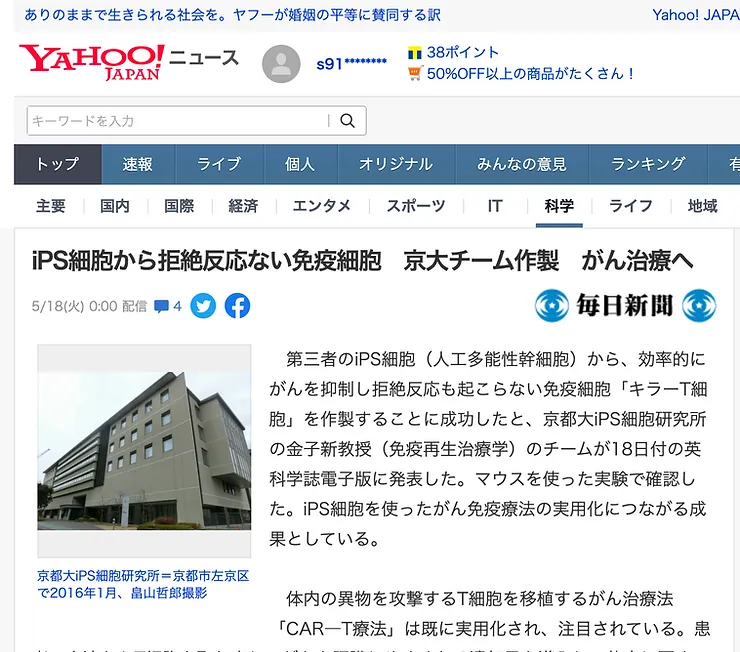 Figure 1
 Figure 2
 Figure 3
 Figure 4