
Unresectable Hepatocellular Carcinoma: Dual Immune Checkpoint Blockade with STRIDE Regimen
Medical Supporter — Informationshinweis
Dieser Artikel ist eine Zusammenfassung internationaler medizinischer Informationen und stellt keine medizinische Beratung dar; er ersetzt nicht die Diagnose oder den Behandlungsplan Ihres behandelnden Arztes. Die dargestellten Informationen stammen aus öffentlichen Veröffentlichungen und offiziellen Angaben führender japanischer medizinischer Einrichtungen; Eignung und Wirkung einer Therapie sind individuell und müssen von einem qualifizierten Arzt beurteilt werden.
HIMALAYA Phase III Trial: Unprecedented Survival Benefit
- January 18, 2022
- Reading time: 2 minutes
On January 18, 2022, AstraZeneca announced results from the HIMALAYA Phase III randomized clinical trial evaluating the efficacy and safety of combined immune checkpoint blockade as first-line treatment for unresectable hepatocellular carcinoma patients ineligible for locoregional therapy.
Trial Design and Treatment Arms
HIMALAYA was an international, multi-institutional, randomized Phase III open-label study enrolling 1,171 treatment-naive patients with unresectable hepatocellular carcinoma ineligible for locoregional therapy, randomized into three arms:
Arm 1 - Imfinzi (Durvalumab) Monotherapy:
- Durvalumab 1,500 mg IV every 4 weeks
- N=389 patients
Arm 2 - STRIDE Regimen (Durvalumab Plus Tremelimumab):
- Durvalumab 1,500 mg IV plus Tremelimumab 300 mg IV on Day 1
- Followed by durvalumab monotherapy continuing every 4 weeks
- N=393 patients
Arm 3 - Sorafenib Control:
- Sorafenib tyrosine kinase inhibitor
- N=389 patients
Primary endpoint: overall survival comparing STRIDE vs Sorafenib
Secondary endpoints: overall survival across all groups, objective response rate, progression-free survival
Primary Efficacy Results
Overall Survival - STRIDE vs Sorafenib:
- STRIDE group: 16.4 months median
- Sorafenib group: 13.8 months median
- 22% reduction in mortality risk with STRIDE regimen
2-Year Overall Survival Rates:
- STRIDE: 40.5%
- Durvalumab monotherapy: 39.6%
- Sorafenib: 32.6%
3-Year Overall Survival Rates:
- STRIDE: 30.7%
- Durvalumab monotherapy: 24.7%
- Sorafenib: 20.2%
Secondary Efficacy Outcomes
Objective Response Rate:
- STRIDE: 20.1%
- Durvalumab monotherapy: 17.0%
- Sorafenib: 5.1%
Median Duration of Response:
- STRIDE: 22.3 months
- Durvalumab monotherapy: 16.8 months
- Sorafenib: 18.4 months
Safety and Tolerability
Grade 3-4 Adverse Events:
- STRIDE: 25.8%
- Durvalumab monotherapy: 12.9%
- Sorafenib: 36.9%
Hepatology-Related Adverse Events:
- STRIDE: 5.9%
- Durvalumab monotherapy: 5.2%
- Sorafenib: 4.5%
Treatment Discontinuation Due to Adverse Events:
- STRIDE: 8.2%
- Durvalumab monotherapy: 4.1%
- Sorafenib: 11%
Safety profiles of STRIDE and durvalumab monotherapy were consistent with prior clinical experience. No novel unexpected adverse events were identified.
Clinical Conclusions
According to Ghassan Abou-Alfa, MD, principal investigator from Memorial Sloan Kettering Cancer Center:
"Treatment-naive, unresectable hepatocellular carcinoma patients ineligible for locoregional therapy have historically demonstrated poor prognosis, necessitating novel therapeutic approaches. The HIMALAYA trial demonstrates that STRIDE combination immunotherapy delivers substantially improved 3-year overall survival rates with a favorable safety profile compared to sorafenib. These results support STRIDE as a potential new first-line treatment paradigm for this patient population with otherwise limited therapeutic options."
Data Source
Related Hepatocellular Carcinoma Treatment Options
- Immunotherapy
- Clinical Trial Therapeutics
- (Lung Cancer) Topotecan and Topotecan Plus Berzosertib Phase II Trial Results
- (Lung Cancer) HER2-Mutant Non-Small Cell Lung Cancer Treatment with Enhertu
- (Lung Cancer) Anti-B7-H3 Antibody DS-7300 Clinical Efficacy
Medical Supporter was formerly certified as an international medical visa guarantor by Japan's Ministry of Foreign Affairs and the Ministry of Economy, Trade and Industry (B-066).
Behandlung in Japan im Blick? Brauchen Sie Informationen und Unterstützung?
Wir helfen Ihnen, die für eine medizinische Reise nach Japan nötigen Informationen zu ordnen, kontaktieren japanische Einrichtungen und organisieren eine Zweitmeinungsberatung.Die Erstberatung ist kostenlos; ein Berater hilft Ihnen, die nächsten Schritte zu klären.
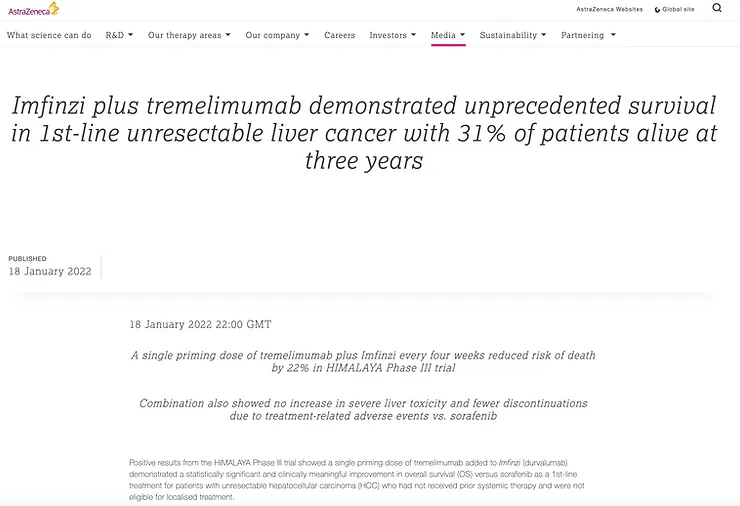 Figure 1
 Figure 2
 Figure 3
 Figure 4