(COVID-19) Cancer Patients May Be More Susceptible to Infection With Worse Outcomes
Medical Supporter — Informationshinweis
Dieser Artikel ist eine Zusammenfassung internationaler medizinischer Informationen und stellt keine medizinische Beratung dar; er ersetzt nicht die Diagnose oder den Behandlungsplan Ihres behandelnden Arztes. Die dargestellten Informationen stammen aus öffentlichen Veröffentlichungen und offiziellen Angaben führender japanischer medizinischer Einrichtungen; Eignung und Wirkung einer Therapie sind individuell und müssen von einem qualifizierten Arzt beurteilt werden.
- February 20, 2020
- 2 min read
On February 14, 2020, Professor He Jianxing's team from the First Affiliated Hospital of Guangzhou Medical University published an online article in The Lancet titled: "Cancer patients are at higher risk of contracting COVID-19, and cancer patients with COVID-19 have worse outcomes."
Researchers collected data from 1,590 confirmed COVID-19 patients across 575 hospitals in 31 provincial administrative regions of China. They found that 1% (18 cases) had a cancer history—a proportion higher than the general Chinese population cancer incidence of 0.29%.
Among the 1,590 cases, 18 had a cancer history; lung cancer accounted for the highest proportion at 28%. Excluding 2 patients with unknown treatment status, of the remaining 16 patients, 4 (25%) had received chemotherapy or surgery in the past month.
Comparison with patients without cancer history:
- Mean age: Cancer patients 63.1 years vs. non-cancer patients 48.7 years
- Smoking history: Cancer patients 22% vs. non-cancer patients 7%
- Dyspnea: Cancer patients 47% vs. non-cancer patients 23%
- Significant CT findings: Cancer patients 94% vs. non-cancer patients 71%
Furthermore, patients who had received chemotherapy or surgery in the past month had a higher risk of severe clinical events (75%) compared to those who had not (43%). Regression modeling—adjusted for age, smoking history, and other risk factors—confirmed that having a cancer history significantly predicts the likelihood of severe events. Among cancer patients, advanced age was the only significant risk factor for severe events.
Researchers concluded that malignancy and anticancer treatments lead to systemic immunosuppression, making cancer patients more susceptible to COVID-19 infection.
Recommended strategies for cancer patients during COVID-19 outbreaks:
- Cancer patients in COVID-19 outbreak areas should consider postponing adjuvant chemotherapy or elective surgery.
- Stricter personal protective measures should be established for cancer patients.
- When cancer patients contract COVID-19, enhanced monitoring and treatment should be provided, especially for elderly patients or those with comorbidities.
Source: https://www.thelancet.com/journals/lanonc/article/PIIS1470-2045(20)30096-6/fulltext
- Discovering the key to aggressive pancreatic cancer!
- New immune enhancers boosting cancer immunotherapy
- Kyoto University launches iPS cell cancer treatment!
Medical Supporter was formerly certified as an international medical visa guarantor by Japan's Ministry of Foreign Affairs and the Ministry of Economy, Trade and Industry (B-066).
Behandlung in Japan im Blick? Brauchen Sie Informationen und Unterstützung?
Wir helfen Ihnen, die für eine medizinische Reise nach Japan nötigen Informationen zu ordnen, kontaktieren japanische Einrichtungen und organisieren eine Zweitmeinungsberatung.Die Erstberatung ist kostenlos; ein Berater hilft Ihnen, die nächsten Schritte zu klären.
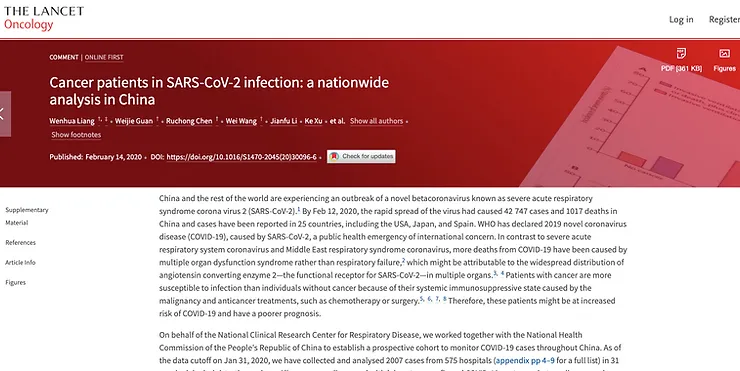 Figure 1
 Figure 2
 Figure 3
 Figure 4