(Colorectal Cancer) TIL Cell Therapy Case Report
Medical Supporter — Information Notice
This article is a summary of international medical information and is not medical advice; it cannot replace the diagnosis or treatment plan of your attending physician. The medical technologies, drug information and clinical data presented here are compiled from public literature and official statements of major Japanese medical institutions; the applicability and outcome of any therapy vary with each patient and must be assessed individually by a qualified physician.
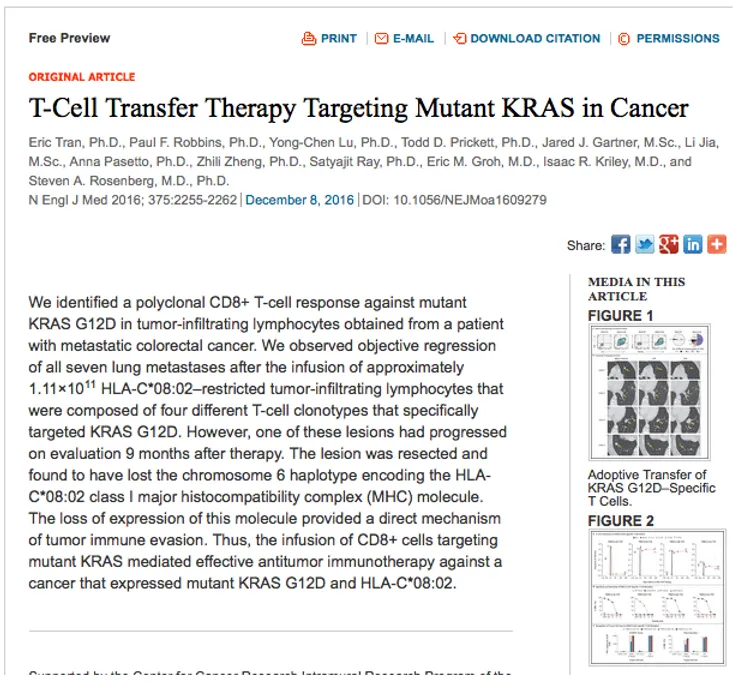
T-Cell Transfer Therapy Targeting Mutant KRAS in Colorectal Cancer
- May 15, 2017
- Reading time: 1 minute
This is a case report published by Dr. Steven A. Rosenberg of the National Cancer Institute (NCI). The original article is titled "T-Cell Transfer Therapy Targeting Mutant KRAS in Cancer" — please refer to the link below for the source article.
Case Summary
The patient was a 50-year-old female with colorectal cancer who responded to TIL (Tumor Infiltrating Lymphocyte) therapy.
CD8+ TILs were harvested from seven lung tumors (which were metastases from colorectal cancer; the TILs were HLA-C*08:02-restricted TILs), expanded to 1.11 × 10¹¹ cells, and then reinfused intravenously into the patient.
These cells targeted KRAS G12D — the most common KRAS mutation.
All seven tumors shrank and remained so for nine months. After that, one site relapsed and was surgically resected. Upon investigation, it was found that the cancer cells at the relapsed site had lost HLA-C*08:02 MHC class I expression on chromosome 6 — the mechanism that had allowed these cancer cells to evade the immune system.
Source: http://www.nejm.org/doi/10.1056/NEJMoa1609279
Tags: #ColorectalCancer #Immunotherapy
- Clinical trial drug
- Immunotherapy
Medical Supporter was formerly certified as an international medical visa guarantor by Japan's Ministry of Foreign Affairs and the Ministry of Economy, Trade and Industry (B-066).
Considering medical care in Japan? Need information and support?
We help you organize the information needed for medical travel to Japan, liaise with Japanese medical institutions, and arrange a second-opinion consultation.The first consultation is free; an advisor will help you clarify the next steps.
Figure 1
Figure 2
Figure 3
Figure 4