(Esophageal Cancer) What Is the Recommended Dosage of Keytruda?
Medical Supporter — Мэдээллийн мэдэгдэл
Энэ нийтлэл нь олон улсын эмнэлгийн мэдээллийн эмхэтгэл бөгөөд эмнэлгийн зөвлөгөө биш; таны эмчийн оношлогоо, эмчилгээний төлөвлөгөөг орлохгүй. Энд буй мэдээлэл нь Японы томоохон эмнэлгийн байгууллагуудын нээлттэй эх сурвалжаас эмхэтгэсэн бөгөөд аливаа эмчилгээний тохиромж, үр дүн өвчтөн бүрээр өөр тул мэргэшсэн эмч тус бүрчлэн үнэлэх ёстой.
- August 24, 2019
- Read time: 2 minutes
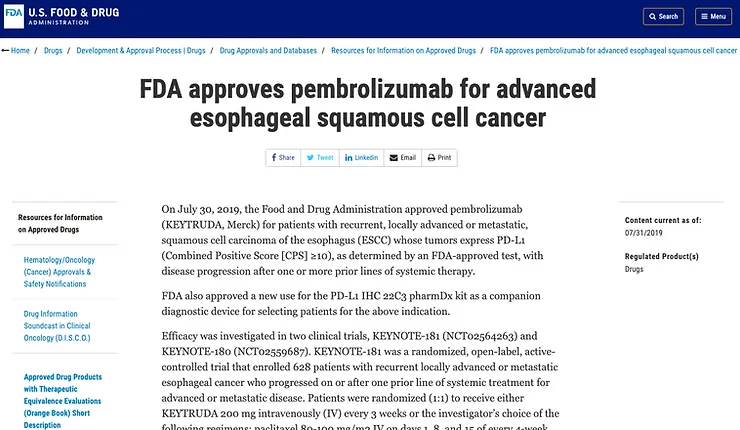
On July 30, 2019, the FDA (U.S. Food and Drug Administration) approved Keytruda for "patients with recurrent or locally metastatic esophageal squamous cell carcinoma (ESCC) who have received one or more prior systemic therapies and have PD-L1 CPS≥10." The FDA also approved the PD-L1 IHC 22C3 pharmDx kit as the companion diagnostic device for the designated patient population.
The KEYNOTE-181 and KEYNOTE-180 clinical trials were the efficacy confirmation trials for Keytruda. KEYNOTE-181 was a 1:1 randomized, open-label, controlled trial involving 628 patients with recurrent or locally metastatic esophageal squamous cell carcinoma who had received one or more prior systemic therapies. The treatment arms were: Keytruda 200 mg IV every 3 weeks, versus physician's choice of chemotherapy — paclitaxel 80–100 mg/m² IV on days 1, 8, and 15 of a 4-week cycle, or docetaxel 75 mg/m² IV every 3 weeks, or irinotecan 180 mg/m² IV every 3 weeks. Randomization was stratified by geographic region and histological subtype (squamous cell carcinoma vs. adenocarcinoma). PD-L1 expression was determined using the PD-L1 IHC 22C3 pharmDx kit.
The primary endpoints of KEYNOTE-181 were overall survival in patients with PD-L1 CPS≥10 ESCC and in all patients. Secondary endpoints included progression-free survival, complete response rate, and duration of response. For PD-L1 CPS≥10 ESCC patients, the hazard ratio for overall survival was 0.64. Median overall survival was 10.3 months for the Keytruda arm vs. 6.7 months for the chemotherapy arm.
KEYNOTE-180 was an open-label, single-arm trial enrolling 121 patients with recurrent or locally metastatic esophageal squamous cell carcinoma who had received two or more prior systemic therapies, using the same dosing regimen as KEYNOTE-181 (except for prior therapy requirements; all other eligibility criteria were identical to KEYNOTE-181).
The primary endpoints of KEYNOTE-180 were objective response rate and duration of response. For PD-L1 CPS≥10 ESCC patients (N=35), the objective response rate was 20%, with duration of response ranging from 4.2 months to over 25.1 months; 71% had a duration ≥6 months and 57% had a duration ≥12 months.
Adverse events in esophageal cancer patients treated with Keytruda were similar to those in melanoma and NSCLC patients. Approximately 20% of patients experienced the following adverse events: fatigue, musculoskeletal pain, decreased appetite, pruritus, diarrhea, nausea, rash, fever, cough, dyspnea, constipation, pain, and abdominal pain.
The recommended dosage of Keytruda for esophageal cancer is 200 mg IV every three weeks.
Disclaimer: The clinical trial data and pharmaceutical information translated by "Medical Supporter" are not intended to encourage participation in clinical trials or use of new drugs. The translated information is for reference only and not for medication guidance. Please consult with healthcare professionals, and refer to the original source text at the bottom of the article for accurate information.
#EsophagealCancer
- Clinical Trial Medications
Medical Supporter was formerly certified as an international medical visa guarantor by Japan's Ministry of Foreign Affairs and the Ministry of Economy, Trade and Industry (B-066).
Японд эмчлүүлэхээр төлөвлөж байна уу? Мэдээлэл, тусламж хэрэгтэй юу?
Бид Японд эмчлүүлэхэд шаардлагатай мэдээллийг эмхэтгэх, Японы эмнэлгийн байгууллагуудтай холбогдох, хоёр дахь саналын зөвлөгөө зохион байгуулахад тусална.Анхны зөвлөгөө үнэгүй; зөвлөх таны дараагийн алхмыг тодорхой болгоход тусална.
Figure 1
Figure 2
Figure 3
Figure 4