medical-blog
Cập nhật lần cuối: 2016-09-29

Olaparib kết hợp Ceralasertib trong ung thư vú bộ ba âm tính di căn: Thử nghiệm VIOLETTE

S
Đội ngũ Medical Supporter
Đội ngũ điều phối y tế quốc tế và biên tập nội dung
Olaparib kết hợp Ceralasertib trong ung thư vú bộ ba âm tính di căn: Thử nghiệm VIOLETTE

Olaparib Plus Ceralasertib in Metastatic Triple-Negative Breast Cancer: VIOLETTE Trial

Medical Supporter — Thông báo thông tin

Bài viết này là bản tổng hợp thông tin y tế quốc tế, không phải lời khuyên y tế và không thể thay thế chẩn đoán hay phác đồ điều trị của bác sĩ điều trị của bạn. Thông tin được biên soạn từ tài liệu công khai và công bố chính thức của các cơ sở y tế hàng đầu Nhật Bản; tính phù hợp và kết quả của mỗi liệu pháp khác nhau ở từng bệnh nhân và phải được bác sĩ có chuyên môn đánh giá riêng.

Mọi phác đồ điều trị cụ thể phải được bác sĩ có giấy phép tại Nhật Bản đánh giá

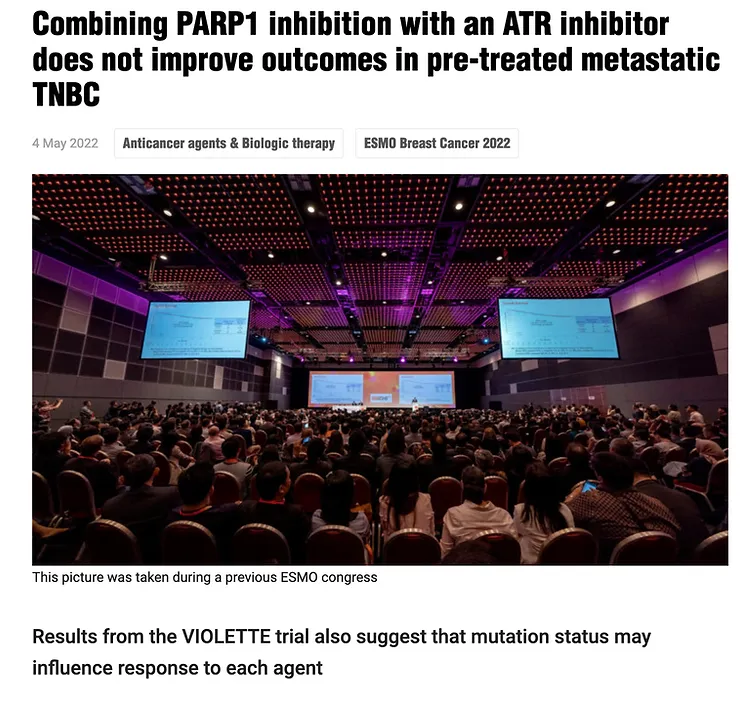
At the ESMO Breast Cancer Congress held in Berlin from May 3 to 5, 2022, results were presented for the VIOLETTE Phase 2 clinical trial. This study investigated the efficacy and safety of combining Olaparib (a PARP inhibitor) with Ceralasertib (an ATR inhibitor) in patients with previously treated metastatic triple-negative breast cancer (TNBC).

Study Design: VIOLETTE Trial

The VIOLETTE trial randomized patients with metastatic TNBC who had failed at least one prior line of therapy into two main arms:

  1. Olaparib Monotherapy
  2. Olaparib + Ceralasertib Combination

The primary endpoint was progression-free survival (PFS).

Key Results

The study results showed a modest numerical improvement in PFS with the combination, but the overall benefit remained limited:

  • Median PFS: 5.3 months for the Olaparib + Ceralasertib group vs. 3.6 months for the Olaparib monotherapy group.
  • Objective Response Rate (ORR):
    • BRCA Mutation Patients: 50.0% (Combination) vs. 44.2% (Monotherapy).
    • HRR Mutation Patients: 20.0% (Combination) vs. 15.0% (Monotherapy).
    • Non-HRR Mutation Patients: 15.4% (Combination) vs. 3.9% (Monotherapy).

While the combination showed some activity in patients without homologous recombination repair (HRR) mutations, it did not provide a significant clinical breakthrough for the broader population.

Safety Profile

Common adverse events included anemia and neutropenia. Grade 3 or higher adverse events occurred in 46.8% of patients in the combination group compared to 35.5% in the monotherapy group.

Conclusion

Dr. Suzette Delaloge from Institut Gustave Roussy noted that while basic research suggested synergy between PARP and ATR inhibition, the VIOLETTE trial did not demonstrate a substantial clinical benefit for pre-treated metastatic TNBC patients with BRCA mutations. However, the signals observed in patients without HRR mutations suggest that ATR inhibition may have independent antitumor activity worth further exploration.

Source: ESMO Daily Reporter - VIOLETTE Trial Highlights

#BreastCancer #TNBC #Olaparib #Ceralasertib #PARPInhibitor #ATRInhibitor #CancerResearch

Đang cân nhắc sang Nhật Bản điều trị? Cần thông tin và hỗ trợ?

Chúng tôi giúp bạn sắp xếp thông tin cần thiết để sang Nhật điều trị, liên hệ các cơ sở y tế Nhật Bản và sắp xếp tư vấn ý kiến thứ hai.Buổi tư vấn đầu tiên miễn phí; chuyên viên sẽ giúp bạn làm rõ các bước tiếp theo.

Trụ sở Fukuoka: +81-92-409-5655
Từng được chứng nhận chính thức, số B-066

Figure 1Figure 1

Figure 2Figure 2

Figure 3Figure 3

Figure 4Figure 4

Bài đọc liên quan