blog
Last updated: 2016-02-16

(Renal) Report on Axitinib in Treatment-Naive Renal Cell Carcinoma Patients

S
Medical Supporter Team
Cross-border medical coordination and editorial review team
(Renal) Report on Axitinib in Treatment-Naive Renal Cell Carcinoma Patients

(Renal) Report on Axitinib in Treatment-Naive Renal Cell Carcinoma Patients

Medical Supporter — Information Notice

This article is a summary of international medical information and is not medical advice; it cannot replace the diagnosis or treatment plan of your attending physician. The medical technologies, drug information and clinical data presented here are compiled from public literature and official statements of major Japanese medical institutions; the applicability and outcome of any therapy vary with each patient and must be assessed individually by a qualified physician.

Any specific treatment plan must be assessed by a licensed physician in Japan
  • November 10, 2016
  • 1 min read

Published at ESMO 2016 by Dr. Brian I. Rini of the Cleveland Clinic in the United States, this retrospective analysis of Phase 2 and Phase 3 clinical trials of Axitinib (Inlyta) in treatment-naive renal cell carcinoma patients demonstrated high response rates, significant tumor reduction, and impressive overall survival (OS) outcomes.

In this trial, 402 patients were enrolled. The starting dose was 5 mg twice daily. At week 4, doses were escalated based on patient ECOG PS scores and tolerability—stepped up to 7 mg, and if well tolerated, further increased to 10 mg. The Phase 3 arm was stratified by ECOG PS, with an Axitinib group (5 mg twice daily) and a Sorafenib group (400 mg), randomized at a 2:1 ratio.

Of the 402 patients, 152 (37.8%) remained on treatment beyond 18 months, while 259 (62.2%) did not. Among the long-term cohort, 119 patients (29.6%) exceeded 2 years, 71 (17.7%) exceeded 3 years, and 28 (7.0%) exceeded 4 years. The median treatment duration was 34.7 months for those treated >18 months and 15 months for those treated ≤18 months.

Patients with longer treatment duration (>18 months) had favorable baseline characteristics: ECOG PS 0, normal ULN, good hemoglobin values, and no bone or liver metastases. Grade 3 or higher adverse events were more common in the >18-month group, including hypertension (25.7%), diarrhea (15.4%), and weight loss (11.2%).

Based on these data, long-term use of Axitinib did not reveal any new or unexpected safety signals.

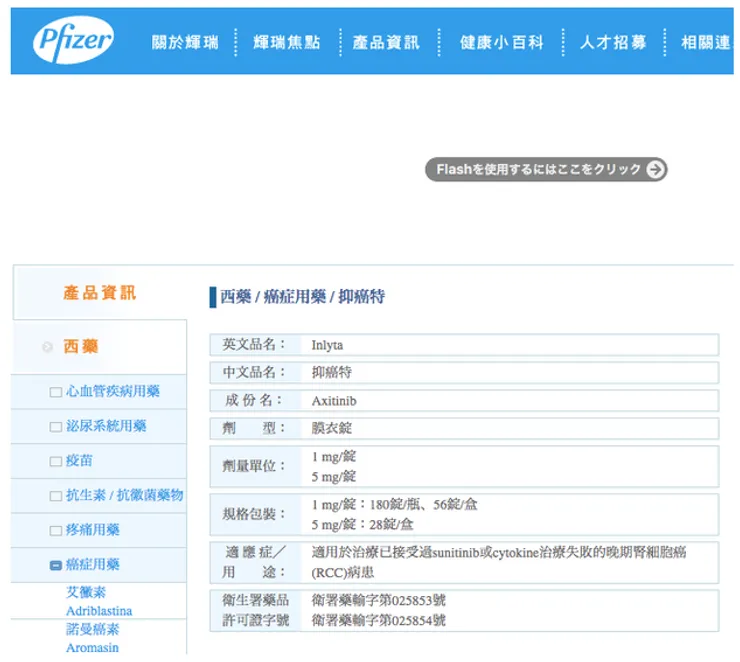
Note: Image sourced from the Pfizer website, where additional information on this drug can be found.

Renal Cancer | Renal Cell Carcinoma

  • Discovering the key to aggressive pancreatic cancer!
  • New immune enhancers boosting cancer immunotherapy
  • Kyoto University launches iPS cell cancer treatment!

Medical Supporter was formerly certified as an international medical visa guarantor by Japan's Ministry of Foreign Affairs and the Ministry of Economy, Trade and Industry (B-066).

Considering medical care in Japan? Need information and support?

We help you organize the information needed for medical travel to Japan, liaise with Japanese medical institutions, and arrange a second-opinion consultation.The first consultation is free; an advisor will help you clarify the next steps.

Fukuoka HQ: +81-92-984-3200
Formerly officially certified, No. B-066

Figure 1Figure 1

Figure 2Figure 2

Figure 3Figure 3

Figure 4Figure 4

Related Cancer Information

Related Reading