
(Colorectal Cancer) TIL Cell Therapy Case Report
Medical Supporter — إشعار معلوماتي
هذه المقالة ملخص لمعلومات طبية دولية وليست نصيحة طبية، ولا يمكن أن تحل محل تشخيص طبيبك المعالج أو خطة العلاج. المعلومات المعروضة مجمّعة من منشورات عامة وبيانات رسمية لكبرى المؤسسات الطبية اليابانية؛ وتختلف ملاءمة ونتائج أي علاج من مريض لآخر ويجب أن يقيّمها طبيب مؤهل لكل حالة على حدة.
T-Cell Transfer Therapy Targeting Mutant KRAS in Colorectal Cancer
- May 15, 2017
- Reading time: 1 minute
This is a case report published by Dr. Steven A. Rosenberg of the National Cancer Institute (NCI). The original article is titled "T-Cell Transfer Therapy Targeting Mutant KRAS in Cancer" — please refer to the link below for the source article.
Case Summary
The patient was a 50-year-old female with colorectal cancer who responded to TIL (Tumor Infiltrating Lymphocyte) therapy.
CD8+ TILs were harvested from seven lung tumors (which were metastases from colorectal cancer; the TILs were HLA-C*08:02-restricted TILs), expanded to 1.11 × 10¹¹ cells, and then reinfused intravenously into the patient.
These cells targeted KRAS G12D — the most common KRAS mutation.
All seven tumors shrank and remained so for nine months. After that, one site relapsed and was surgically resected. Upon investigation, it was found that the cancer cells at the relapsed site had lost HLA-C*08:02 MHC class I expression on chromosome 6 — the mechanism that had allowed these cancer cells to evade the immune system.
Source: http://www.nejm.org/doi/10.1056/NEJMoa1609279
Tags: #ColorectalCancer #Immunotherapy
- Clinical trial drug
- Immunotherapy
Medical Supporter was formerly certified as an international medical visa guarantor by Japan's Ministry of Foreign Affairs and the Ministry of Economy, Trade and Industry (B-066).
هل تفكر في تلقّي العلاج في اليابان؟ هل تحتاج إلى معلومات ومساعدة؟
نساعدك في تنظيم المعلومات اللازمة للسفر الطبي إلى اليابان، والتواصل مع المؤسسات الطبية اليابانية، وترتيب استشارة رأي ثانٍ.الاستشارة الأولى مجانية؛ سيساعدك المستشار على توضيح الخطوات التالية.
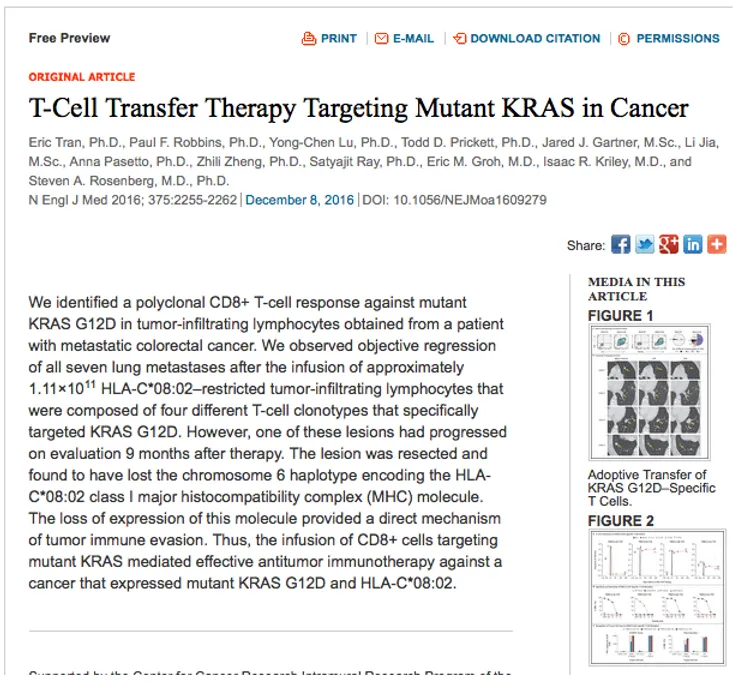 Figure 1
 Figure 2
 Figure 3
 Figure 4