
(Kidney Cancer) Opdivo + Cabometyx Combination Therapy Approved in Japan
Medical Supporter — إشعار معلوماتي
هذه المقالة ملخص لمعلومات طبية دولية وليست نصيحة طبية، ولا يمكن أن تحل محل تشخيص طبيبك المعالج أو خطة العلاج. المعلومات المعروضة مجمّعة من منشورات عامة وبيانات رسمية لكبرى المؤسسات الطبية اليابانية؛ وتختلف ملاءمة ونتائج أي علاج من مريض لآخر ويجب أن يقيّمها طبيب مؤهل لكل حالة على حدة.
On August 25, 2021, Ono Pharmaceutical and Takeda Pharmaceutical announced that Opdivo (nivolumab) plus Cabometyx (cabozantinib) combination therapy received approval for treating patients with unresectable or metastatic renal cell carcinoma.
Kidney cancer affects approximately 25,000 new patients per year in Japan, with approximately 8,550 deaths annually. Renal cell carcinoma accounts for 90% of these cases.
This approval was based on the CheckMate-9ER Phase III clinical trial results. The trial assigned patients in a 1:1 ratio to either the Opdivo combination therapy group (every 2 weeks: Opdivo 240mg + once-daily Cabometyx 40mg) or the Sunitinib group (every 6 weeks: Sunitinib 50mg once daily for 4 weeks followed by 2 weeks rest). The primary endpoint was progression-free survival (PFS), and secondary endpoints were overall survival (OS) and objective response rate (ORR). Analysis results showed significant improvement in progression-free survival, overall survival, and objective response rate. The safety profile of the Opdivo plus Cabometyx combination therapy was consistent with previously reported adverse event data.
Source: https://www.ono.co.jp/news/20210825.html
Medical Supporter was formerly certified as an international medical visa guarantor by Japan's Ministry of Foreign Affairs and the Ministry of Economy, Trade and Industry (B-066).
هل تفكر في تلقّي العلاج في اليابان؟ هل تحتاج إلى معلومات ومساعدة؟
نساعدك في تنظيم المعلومات اللازمة للسفر الطبي إلى اليابان، والتواصل مع المؤسسات الطبية اليابانية، وترتيب استشارة رأي ثانٍ.الاستشارة الأولى مجانية؛ سيساعدك المستشار على توضيح الخطوات التالية.
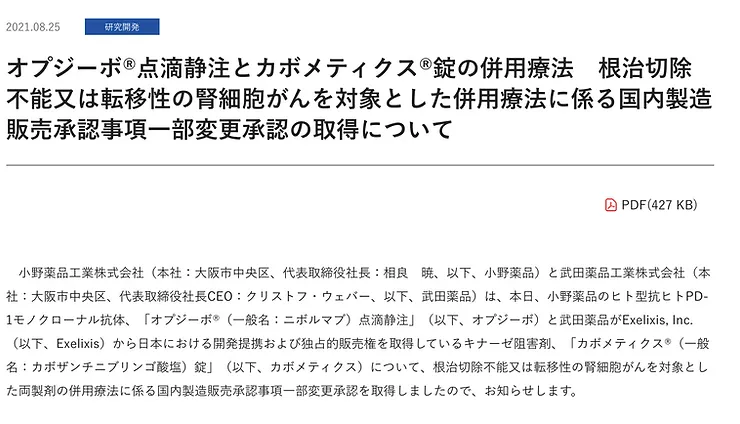 Figure 1
 Figure 2
 Figure 3
 Figure 4