
(Urothelial Carcinoma) What Is the Objective Response Rate of Erdafitinib?
Medical Supporter — ประกาศข้อมูล
บทความนี้เป็นการสรุปข้อมูลทางการแพทย์ระหว่างประเทศ ไม่ใช่คำแนะนำทางการแพทย์ และไม่สามารถใช้แทนการวินิจฉัยหรือแผนการรักษาของแพทย์ผู้ดูแลของคุณได้ ข้อมูลที่นำเสนอรวบรวมจากเอกสารสาธารณะและคำชี้แจงอย่างเป็นทางการของสถาบันการแพทย์ชั้นนำของญี่ปุ่น ความเหมาะสมและผลของการรักษาแต่ละแบบแตกต่างกันไปในผู้ป่วยแต่ละราย และต้องได้รับการประเมินเป็นรายบุคคลโดยแพทย์ที่มีคุณสมบัติ
- August 31, 2019
- Reading time: 2 minutes
On July 25, 2019, Yohann Loriot published results in The New England Journal of Medicine from a Phase II clinical trial evaluating erdafitinib monotherapy — a FGFR1–4 tyrosine kinase inhibitor — in patients with locally advanced or metastatic urothelial carcinoma harboring fibroblast growth factor receptor (FGFR) gene mutations.
This Phase II open-label trial enrolled patients with FGFR-mutated locally advanced or metastatic urothelial carcinoma. Patients received erdafitinib 6–10 mg once daily in 28-day cycles. The primary endpoint was objective response rate (ORR); secondary endpoints included progression-free survival (PFS), overall survival (OS), and others.
FGFR mutations occur at high frequency in urothelial carcinoma, and patients with FGFR mutations may have suboptimal responses to immunotherapy. Based on Phase I data confirming the antitumor activity of FGFR1–4 tyrosine kinase inhibition in FGFR-mutated patients, this trial was initiated to confirm efficacy.
Patient Characteristics:
| Parameter | Value |
|---|---|
| Median age | 68 years (range: 36–87) |
| ECOG PS 0 | 51% |
| ECOG PS 1 | 42% |
| ECOG PS 2 | 7% |
| Progressive disease after chemotherapy | 88% |
| No prior treatment | 12% |
| Progressive disease after immunotherapy | 22% |
| 0 prior regimens | 11% |
| 1 prior regimen | 45% |
| 2 prior regimens | 43% |
| Visceral metastases | 79% |
| Creatinine clearance <60 mL/min | 53% |
Efficacy Results:
The primary endpoint ORR was 40%: complete response 3%, partial response 37%, stable disease 39%. Median duration of treatment was 5.6 months; median time to tumor response was 1.4 months.
ORR by prior treatment: post-chemotherapy progression 40% / treatment-naive 42% / post-immunotherapy progression 59%.
ORR by number of prior regimens: 0 regimens 36% / 1 regimen 38% / 2 regimens 38% / 3 regimens 60% / 4 regimens 50%.
Secondary endpoints: median PFS 5.5 months; 12-month PFS rate 19%. Median OS 13.8 months; 12-month OS rate 55%.
Safety:
Overall adverse event rate was 100%; Grade 3–4 adverse events occurred in 67% of patients. Most common Grade 3–4 events were hyponatremia (11%), stomatitis (10%), and asthenia (7%). The most common reason for treatment discontinuation was disease progression.
Based on the Phase II trial results, Yohann Loriot concluded that erdafitinib achieved a 40% ORR in FGFR-mutated locally advanced or metastatic urothelial carcinoma patients, with Grade 3–4 adverse events occurring in more than half of patients.
Source: Erdafitinib in Locally Advanced or Metastatic Urothelial Carcinoma (N Engl J Med 2019; 381:338–348 DOI: 10.1056/NEJMoa1817323)
#UrothelialCarcinoma
- Clinical trial drugs
Medical Supporter was formerly certified as an international medical visa guarantor by Japan's Ministry of Foreign Affairs and the Ministry of Economy, Trade and Industry (B-066).
กำลังพิจารณาเดินทางไปรักษาที่ญี่ปุ่น? ต้องการข้อมูลและความช่วยเหลือไหม?
เราช่วยคุณจัดเตรียมข้อมูลที่จำเป็นสำหรับการเดินทางไปรักษาที่ญี่ปุ่น ติดต่อสถาบันการแพทย์ญี่ปุ่น และจัดการปรึกษาความเห็นที่สองการปรึกษาครั้งแรกฟรี ที่ปรึกษาจะช่วยให้คุณเห็นขั้นตอนต่อไปชัดเจน
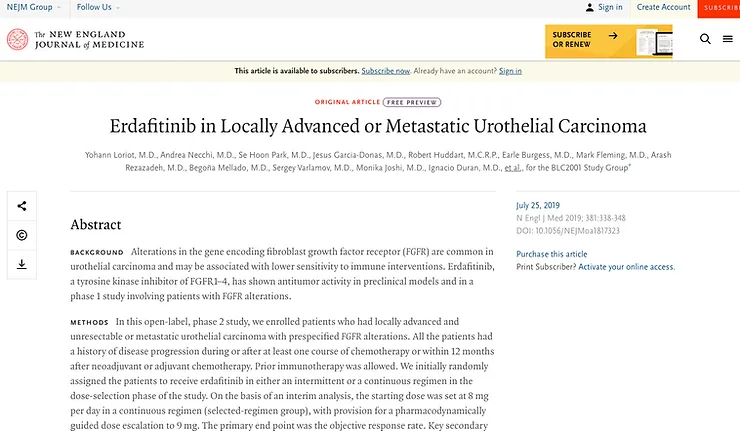 Figure 1
 Figure 2
 Figure 3
 Figure 4